
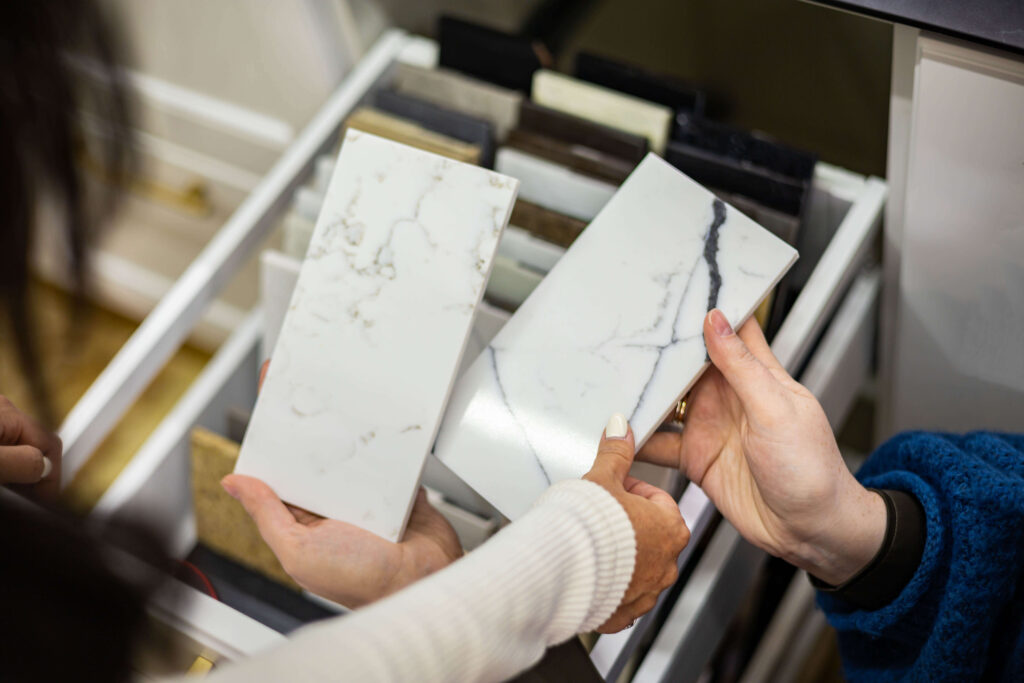
Choosing a kitchen worktop is about much more than finding a colour that matches your cabinets.
Your worktop will be used every day for food preparation, cooking, entertaining and family life, so durability, cleaning, heat resistance and maintenance should all influence your decision.
For homeowners looking at kitchen worktops in Manchester, quartz, granite and porcelain are three of the most popular premium options. All three can create a beautiful, long-lasting kitchen, but they have different strengths.
So, which is the best kitchen worktop material for you?
This guide compares quartz, granite and porcelain to help you make a more informed choice.
Quartz, Granite and Porcelain at a Glance
| Feature | Quartz | Granite | Porcelain |
|---|---|---|---|
| Material | Engineered stone | Natural stone | Manufactured ceramic surface |
| Appearance | Consistent, wide design choice | Every slab is unique | Wide range of stone-inspired and contemporary designs |
| Maintenance | Low | Slightly more care may be needed | Low |
| Sealing | Not normally required | May require sealing depending on the stone | Not required |
| Heat resistance | Good, but trivets recommended | Very good, though trivets are still sensible | Excellent |
| Stain resistance | Very good | Good when appropriately treated | Excellent |
| Outdoor suitability | Generally not recommended unless specifically approved | Depends on stone and application | Some products are highly suitable |
| Best for | Busy family kitchens and versatile design | Natural character and individuality | Modern kitchens and high-performance applications |
The right choice depends on how you use your kitchen and what matters most to you.
Quartz Worktops: Versatile and Low Maintenance
Quartz has become a popular choice for modern kitchens because it combines the appearance of stone with the consistency of an engineered surface.
Granite & Marble Shop’s quartz worktops are manufactured using more than 90% natural stone combined with resins and pigments. The result is a non-porous material available in a wide variety of colours and patterns.
Why Choose Quartz?
One of quartz’s biggest advantages is versatility.
Because it is engineered, manufacturers can produce everything from understated neutral surfaces to dramatic designs inspired by marble and natural stone.
This makes quartz suitable for:
• Contemporary handleless kitchens
• Traditional Shaker cabinetry
• Large kitchen islands
• Minimalist white schemes
• Dark statement kitchens
• Marble-inspired interiors
Granite & Marble Shop works with established quartz brands including Silestone, Caesarstone, CRL, IQ Quartz and others, giving homeowners considerable choice in colour and finish.
Is Quartz Easy to Maintain?
Yes. Quartz is non-porous and does not normally require sealing.
For everyday cleaning, Granite & Marble Shop recommends warm soapy water followed by drying with a microfibre cloth.
This makes it particularly attractive for busy family kitchens where homeowners want a premium surface without a complicated maintenance routine.
Can You Put Hot Pans on Quartz?
It is better not to.
Although quartz is durable, the resins within the material can be affected by excessive or sudden heat. Use a trivet or heat-resistant mat beneath hot pans, roasting trays and heat-producing appliances.
Quartz is therefore a strong all-round option, but it should not be treated as completely heat-proof.
Granite Worktops: Natural Character and Individuality
If you want a worktop that is completely unique, granite is difficult to replicate.
Granite is a natural material quarried from the earth, meaning variations in veining, colour, mineral deposits and pattern occur naturally from one slab to another. Granite & Marble Shop encourages customers to view full slabs at its Stockport showroom so they can appreciate these variations before choosing.
Why Choose Granite?
Granite is particularly well suited to homeowners who want their kitchen to feature genuine natural stone.
Its advantages include:
• Unique natural patterns
• Excellent durability
• Strong heat resistance
• A wide range of colours
• Timeless appearance
• Suitability for traditional and contemporary kitchens
Dark granites can create dramatic contrast against pale cabinetry, while softer greys and whites can work beautifully in more understated interiors.
Does Granite Need Sealing?
This depends on the particular granite and how it has been treated.
Granite & Marble Shop seals its natural-stone worktops before they leave the factory and advises customers on appropriate ongoing care. Its own guidance notes that some granite may require further sealing over time.
Rather than assuming every granite worktop needs sealing on a fixed annual schedule, follow the recommendations supplied for your particular stone.
Spills — especially oils, wine and strongly coloured foods — should still be cleaned promptly.
Is Granite More Difficult to Look After?
Not necessarily.
Day-to-day cleaning is straightforward, but natural stone generally requires slightly more consideration than quartz or porcelain.
If you value natural variation and are comfortable following the appropriate aftercare guidance, granite worktops in Manchester can provide a highly distinctive and long-lasting finish.
Porcelain Worktops: Modern and High Performing
Porcelain has become an increasingly popular choice for homeowners who want a slim, contemporary surface with strong technical performance.
It is manufactured at extremely high temperatures to create a dense, durable and non-porous material.
Granite & Marble Shop’s porcelain range includes products such as Dekton and Infinity, which offer stone-inspired designs alongside high resistance to heat, scratches and staining.
Why Choose Porcelain?
Porcelain offers several practical advantages:
• High resistance to heat
• Strong scratch resistance
• Non-porous surface
• Excellent stain resistance
• No sealing requirement
• A wide variety of designs
• Slim contemporary profiles
• Certain products suitable for outdoor kitchens
Dekton, for example, is also highly resistant to UV exposure, making suitable designs an option for outdoor applications.
Are There Any Disadvantages?
Porcelain is exceptionally hard, but that does not make it impossible to damage.
Edges and corners can be vulnerable to heavy impacts, so care should still be taken with heavy cookware.
Its fabrication also requires specialist equipment and experience, particularly around cut-outs and edges.
This makes professional templating, fabrication and fitting especially important.
Which Worktop Is Best for a Busy Family Kitchen?
For many households, quartz worktops in Manchester offer an excellent balance of practicality and appearance.
Quartz is easy to clean, does not require sealing and is available in an enormous range of designs.
It may be particularly attractive if you:
• Have children
• Cook regularly
• Want minimal maintenance
• Prefer predictable colour and veining
• Want a marble-inspired look without choosing marble
Porcelain offers similarly low maintenance with greater heat resistance, while granite can still be an excellent family-kitchen surface when correctly cared for.
There is no single material that wins every category.
Which Is Best for a Statement Kitchen?
If individuality is your priority, granite has a major advantage.
Because every slab has developed naturally, your worktop will have colour and pattern variations that cannot be reproduced exactly.
If you prefer dramatic veining with greater consistency between slabs, quartz or porcelain may be the better choice.
Porcelain is particularly effective for sleek, architectural schemes, while modern quartz designs can create convincing marble-inspired statement islands and splashbacks.
Which Worktop Is Most Heat Resistant?
Porcelain generally offers the strongest resistance to very high temperatures, particularly products designed specifically for demanding indoor and outdoor applications.
Granite also has excellent natural heat resistance.
Quartz performs well in normal kitchen use, but direct contact with very hot cookware should be avoided because of the resin content.
Regardless of the material, using trivets is a sensible habit. Granite & Marble Shop recommends protecting worktops from hot pans as part of its general aftercare guidance.
Which Worktop Is Easiest to Maintain?
Quartz and porcelain are the simplest choices if low maintenance is the priority.
Both are non-porous and do not normally need sealing. Everyday cleaning generally involves warm water, mild detergent and a soft cloth.
Granite may need periodic attention depending on the type of stone and its existing treatment.
Granite & Marble Shop also stocks specialist Lithofin care products for natural and engineered stone surfaces if additional cleaning or protection is required.
What About Price?
It is tempting to label quartz as mid-range, granite as expensive and porcelain as premium, but real-world pricing is more complicated.
The cost of any worktop will depend on:
• Brand or stone selected
• Slab size
• Thickness
• Colour and pattern
• Number of cut-outs
• Edge profile
• Upstands and splashbacks
• Size of the kitchen island
• Fabrication requirements
• Installation complexity
Some premium quartz surfaces can cost more than certain granites, while rare natural stone can be considerably more expensive than standard quartz.
The best approach is to compare complete quotations based on the actual layout of your kitchen rather than material price alone.
Quartz vs Granite vs Porcelain: Which Should You Choose?
Choose quartz if you want:
• Low maintenance
• Lots of colours and designs
• A consistent finish
• Strong everyday durability
• A practical family-kitchen surface
Choose granite if you want:
• Genuine natural stone
• A completely individual slab
• Excellent durability
• Strong heat resistance
• Timeless character
Choose porcelain if you want:
• Excellent heat and stain resistance
• Minimal maintenance
• A sleek contemporary appearance
• Slim surface options
• Potential indoor and outdoor versatility
Ultimately, the best material is the one that suits the way you cook, clean, entertain and live.
Frequently Asked Questions
Is quartz better than granite?
Neither is universally better. Quartz offers consistency and minimal maintenance, while granite provides natural variation and excellent durability. Your priorities will determine the better option.
Is porcelain better than quartz for kitchen worktops?
Porcelain offers excellent heat and UV resistance, while quartz provides a huge choice of colours and patterns and is very easy to maintain. Both are strong choices for busy kitchens.
Do quartz and porcelain worktops need sealing?
No. Both are non-porous and do not normally require sealing.
Should I see a full slab before choosing?
Where possible, yes — especially with granite. Natural stone can vary significantly within one slab, and viewing the full surface gives you a much better idea of its true colour and pattern. Granite & Marble Shop displays full slabs at its Stockport showroom.
Find Your Perfect Kitchen Worktop in Manchester
Choosing between quartz, granite and porcelain is much easier when you can compare the materials in person.
Granite & Marble Shop supplies, templates, fabricates and installs bespoke stone worktops for customers across Stockport, Manchester, Bramhall, Wilmslow and the surrounding areas.
At the Stockport showroom, you can explore full slabs of granite alongside extensive quartz and porcelain collections and speak to the team about your kitchen, lifestyle and budget.
Visit Roland Road, Reddish, Stockport, SK5 6TJ, or call 0161 480 4676 to discuss your project.